The short version
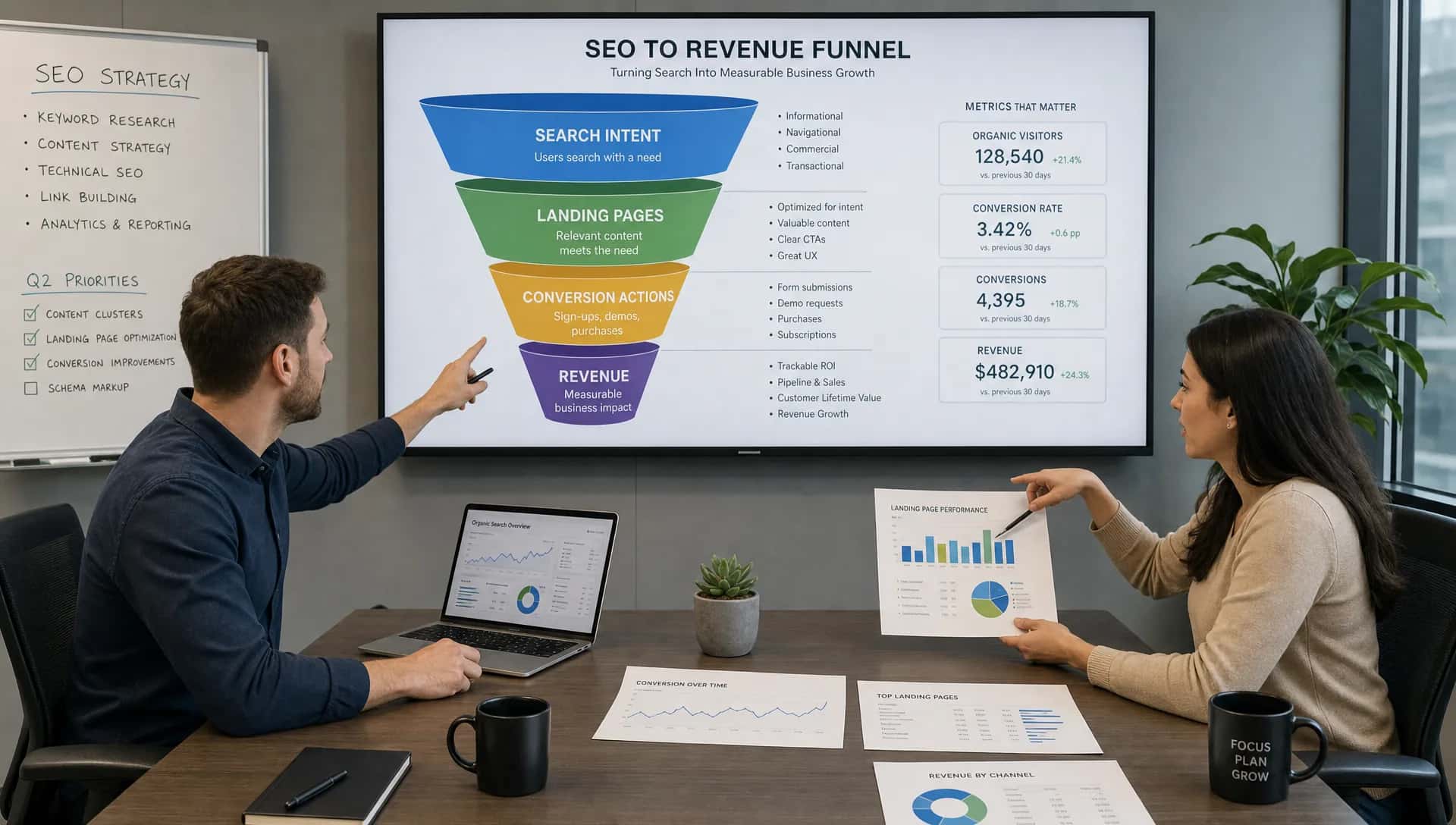
Search engine optimization services drive revenue when they connect buyer intent to crawlable pages, persuasive content, conversion-focused UX, and measurement that tracks qualified leads, pipeline, or sales.
01
Why SEO revenue starts before the ranking report
Most companies do not invest in SEO because they want rankings. They invest because they want more qualified leads, stronger pipeline, lower acquisition costs, and more predictable revenue.
That distinction matters. Rankings and traffic are useful indicators, but they are not the business outcome. The real value of search engine optimization services is their ability to connect what people are already searching for with pages, offers, and conversion paths that move them closer to buying.
A revenue-focused SEO strategy does not ask, “How do we get more clicks?” It asks, “Which searches indicate commercial opportunity, what does the buyer need next, and how do we turn that visit into measurable business growth?”
02
SEO turns existing demand into measurable opportunity
Search is one of the clearest signals of intent in digital marketing. When someone searches for a solution, comparison, service, pricing information, or implementation guide, they are revealing a need. SEO captures that demand without interrupting the buyer.
This is why SEO can drive revenue differently from many awareness channels. A person searching “best CRM for small business,” “SEO agency for SaaS,” or “how to automate lead follow-up” is not passively scrolling. They are trying to solve a problem. If your brand appears with a helpful, credible, and conversion-ready page, you have a chance to become part of their buying process.
According to Google Search Central, SEO is fundamentally about helping search engines understand your content and helping users find your site. For businesses, that means the technical work, content strategy, and user experience all need to support a commercial outcome.
03
How search engine optimization services create revenue
SEO services drive revenue by improving three things at once: visibility, relevance, and conversion. Visibility gets your brand discovered. Relevance ensures the right audience lands on the right page. Conversion turns that visit into a lead, sale, booking, demo request, or other business outcome.
A strong SEO engagement typically connects several workstreams into one growth system.
The key is integration. A technically optimized site with weak content will struggle to persuade. Great content on a slow, confusing website will leak conversions. High rankings for low-intent keywords may inflate traffic without creating sales opportunities.
Revenue comes from aligning every layer of SEO with the buyer journey.
| SEO workstream | Revenue lever | What to measure |
|---|---|---|
| Keyword and intent research | Finds searches linked to real buyer needs | Commercial keyword rankings, qualified organic sessions |
| Technical SEO | Makes pages easier to crawl, index, and use | Indexed pages, site health, Core Web Vitals, crawl errors |
| Content strategy | Builds authority across topics buyers care about | Organic entrances, assisted conversions, engaged sessions |
| On-page optimization | Aligns pages with search intent and conversion goals | Click-through rate, rankings, form starts, scroll depth |
| Conversion-focused UX | Reduces friction between visit and action | Conversion rate, demo requests, calls, purchases |
| Analytics and reporting | Connects SEO activity to pipeline and revenue | Leads, opportunities, revenue, cost per acquisition |
| AI search optimization | Improves brand visibility in answer engines and AI-driven discovery | Branded mentions, cited content, referral quality |
04
SEO captures buyers at different stages of the journey
Not every organic visitor is ready to buy today, and that is not a problem. A well-built SEO system gives buyers the right page for their current level of awareness.
Top-of-funnel content helps people define a problem. Middle-of-funnel content helps them compare approaches and evaluate options. Bottom-of-funnel pages help them choose a provider, request a quote, book a call, or make a purchase.
For example, a company selling automation services might build content around workflow bottlenecks, AI automation use cases, tool comparisons, implementation guides, and service pages for specific industries. Each page plays a different role, but together they create a path from curiosity to conversion.
This matters because buyers rarely move in a straight line. They search, compare, leave, return, ask colleagues, look for proof, and search again. SEO increases the number of useful entry points into that process.
05
Technical SEO protects revenue from invisible friction
Technical SEO is often described as “backend work,” but its revenue impact is very practical. If search engines cannot crawl or index your most important pages, those pages cannot reliably rank. If users land on slow, broken, or confusing pages, they are less likely to convert.
Technical SEO can influence revenue through:
Google’s documentation on Core Web Vitals explains how loading speed, interactivity, and visual stability help define user experience. While technical performance alone does not guarantee rankings or revenue, poor performance can create friction at the exact moment a prospect is deciding whether to trust you.
In revenue terms, technical SEO is risk reduction. It prevents qualified demand from being lost because of site issues that buyers never report but search engines and analytics often reveal.
- Faster page experiences that reduce abandonment and improve engagement
- Clean site architecture that helps users and search engines find important pages
- Proper indexing controls so valuable pages appear in search results
- Mobile-friendly layouts that support buyers across devices
- Structured data that helps search engines interpret page context
- Reduced duplicate content and technical errors that dilute authority
06
Content becomes a sales asset, not just a traffic asset
Many companies publish blog posts because they believe “more content” equals more SEO growth. That is only partly true. Content drives revenue when it is built around buyer questions, decision criteria, objections, and use cases.
A revenue-focused content strategy answers questions such as:
This is where SEO and sales alignment become powerful. Search data shows what buyers ask publicly. Sales calls reveal what buyers ask privately. Combining both helps create content that ranks, educates, and supports conversion.
For service businesses, this may include industry landing pages, comparison pages, ROI-focused articles, implementation guides, FAQ content, case-study-driven pages, and problem-solution resources. For ecommerce brands, it may include category optimization, buying guides, product education, and content that reduces purchase anxiety.
- What problems does our ideal customer search before they know they need us?
- What comparisons do they make before choosing a solution?
- What objections stop them from converting?
- What proof do they need before contacting sales?
- Which pages should support sales conversations after a lead enters the pipeline?

07
Conversion is where SEO revenue is won or lost
Traffic is only valuable if the page gives visitors a clear next step. This is why modern SEO services should overlap with conversion strategy, UX, copywriting, and web development.
A visitor who lands on a page should quickly understand where they are, why the page is relevant, what problem is being solved, and what action to take next. If the page is vague, cluttered, slow, or disconnected from the search intent, the business may pay for SEO activity without capturing the full value of organic demand.
Conversion-focused SEO looks at page structure, messaging, trust signals, calls to action, forms, internal links, and offer alignment. A service page targeting high-intent searches might need proof points, clear positioning, client outcomes, a concise process, and a frictionless way to book a call. An educational article might need internal paths to related service pages, downloadable resources, newsletter capture, or contextual invitations to speak with an expert.
This is one reason SitesBrand approaches growth through SEO, AI search optimization, automation, design, and development rather than treating SEO as an isolated task. When organic visibility connects to a persuasive website and clear follow-up systems, SEO has a better chance of turning into revenue.
08
SEO can lower acquisition costs over time
Paid media can produce fast feedback, but costs often rise as competition increases. SEO typically takes longer to build, yet successful organic assets can continue attracting qualified visitors after the initial work is done.
That does not mean SEO is free. Strategy, content, technical improvements, design, development, and measurement all require investment. But once strong pages rank and convert, they can reduce dependence on paid traffic and improve blended acquisition costs.
The compounding effect usually comes from three sources. First, high-performing pages can attract traffic month after month. Second, strong topical authority can make it easier for related pages to perform. Third, content can support multiple channels, including sales enablement, email nurturing, social distribution, and AI search visibility.
This is why SEO should be evaluated as a long-term revenue system, not a one-off campaign.
09
How to measure SEO revenue impact
The most common SEO reporting mistake is stopping at rankings. Rankings matter, but they are an intermediate metric. If leadership cares about revenue, reporting should connect organic search to business outcomes.
For B2B companies, SEO attribution often requires connecting analytics with CRM data. A visitor may read three organic articles, return through a branded search, book a call, and close weeks later. Last-click attribution may understate SEO’s role, while assisted conversion reporting gives a more complete view.
For ecommerce companies, product and category page performance should be tied to revenue, average order value, conversion rate, and repeat purchase behavior. SEO can influence the entire path, from non-branded discovery to product education and branded search demand.
| Funnel stage | Useful SEO metrics | Revenue question answered |
|---|---|---|
| Visibility | Impressions, rankings, share of search, branded search growth | Are more qualified buyers discovering us? |
| Traffic quality | Organic sessions, engaged sessions, landing page performance | Are we attracting the right audience? |
| Conversion | Form fills, calls, bookings, purchases, newsletter signups | Are visitors taking valuable actions? |
| Pipeline | Qualified leads, opportunities, deal value, assisted conversions | Is SEO influencing sales opportunities? |
| Revenue | Closed-won revenue, ecommerce revenue, customer acquisition cost | Is organic search contributing to profitable growth? |
| Retention and expansion | Returning organic users, support content engagement, customer education | Is SEO supporting customer value after purchase? |
10
Common mistakes that keep SEO from driving revenue
SEO fails to produce revenue when it is managed as a checklist instead of a growth system. Some of the most common mistakes include chasing high-volume keywords with little buying intent, publishing content without a conversion path, ignoring technical issues, and treating SEO separately from web design or sales strategy.
Another mistake is measuring activity instead of outcomes. Publishing ten articles per month means little if those articles do not target the right intent, strengthen topical authority, or support conversion. Likewise, ranking for a keyword may not matter if the page does not generate qualified leads.
Businesses also miss revenue when they neglect bottom-of-funnel pages. Educational content is valuable, but service pages, comparison pages, industry pages, and high-intent landing pages often play a more direct role in pipeline generation. A balanced SEO strategy should include both demand creation and demand capture.
11
AI search changes the SEO revenue equation
In 2026, organic discovery is no longer limited to traditional blue links. Buyers use search engines, AI assistants, answer boxes, summaries, review platforms, communities, and comparison content to evaluate brands.
That does not make SEO less important. It makes SEO broader. Brands need content that is clear, credible, well-structured, and easy for both humans and AI systems to understand. Entity clarity, expert content, consistent brand positioning, structured information, and authoritative citations all matter more as search experiences become more answer-driven.
AI search optimization, answer engine optimization, and generative engine optimization are part of this shift. If you want to explore these topics further, the SitesBrand blog, modern SEO services guide, and SEO tools guide cover SEO, AEO, GEO, automation, and digital growth strategies for modern search behavior.
The revenue opportunity is straightforward. If buyers ask AI-driven systems for recommendations, comparisons, or explanations, your brand needs to be discoverable, understandable, and trustworthy in those environments too.
12
What to look for in revenue-focused search engine optimization services
A strong SEO partner should be able to explain how their work connects to business outcomes. They should ask about your customers, margins, sales cycle, offers, conversion rates, and current acquisition channels before recommending tactics.
Look for an approach that includes strategic research, technical diagnostics, content planning, on-page optimization, conversion improvements, and reporting tied to business metrics. The best SEO work is not just about increasing traffic. It is about building a system where organic visibility supports revenue at each stage of the buyer journey.
For ambitious brands, the strongest results often come when SEO is connected with automation, UX design, web development, and sales follow-up. That way, a qualified organic visitor does not just land on a page. They enter a journey that is intentionally built to convert.
13
Turn organic search into a revenue system
Search engine optimization services drive revenue when they are built around buyer intent, technical performance, persuasive content, conversion-focused design, and clear measurement.
If your organic strategy is producing traffic but not enough pipeline, it may be time to look beyond rankings and audit the full journey. SitesBrand helps ambitious brands connect SEO, AI search optimization, automation, design, and development into strategy-led growth systems. Start with a free audit to identify where organic search can create more measurable revenue for your business.
14
Frequently asked questions
How long do search engine optimization services take to drive revenue?
SEO timelines vary based on competition, website health, content quality, authority, and sales cycle length. Some technical and conversion improvements can show impact quickly, while meaningful organic growth often takes several months of consistent execution.
Which SEO services usually have the fastest revenue impact?
The fastest impact often comes from optimizing existing high-intent pages, fixing technical issues that block performance, improving calls to action, refreshing pages already ranking near page one, and strengthening service or product pages that attract qualified traffic.
Can SEO replace paid ads?
SEO does not always replace paid ads, but it can reduce dependence on them over time. Many companies use paid media for speed and testing while SEO builds a more durable organic acquisition channel.
How do I know if an SEO agency is revenue-focused?
A revenue-focused agency talks about leads, pipeline, conversion rates, customer acquisition cost, and business goals, not just rankings. They should connect keyword strategy, content, technical work, and reporting to measurable commercial outcomes.
What makes SEO different in 2026?
SEO now includes traditional search visibility plus AI-driven discovery. Brands need technically sound websites, helpful content, strong topical authority, clear positioning, and content that can be understood by both search engines and answer-based systems.