
The short version
SEO services in 2026 should not be a loose bundle of keywords, blogs, links, and ranking reports. A serious engagement should improve discoverability, technical clarity, expert content, AI-search readiness, conversion paths, and measurement tied to qualified leads or revenue.
01
SEO services in 2026 are about discoverability, not just rankings
SEO services used to be easier to define. A provider audited your site, found keywords, fixed technical issues, wrote content, built links, and reported rankings. In 2026, that definition is too narrow.
Search is fragmented across traditional results, AI-generated answers, voice assistants, social search, review platforms, marketplaces, and industry-specific discovery channels. Buyers may still click a blue link, but they may also ask an AI tool for a shortlist, compare brands without visiting your site, or convert only after seeing your expertise repeated across multiple trusted sources.
That does not make SEO less valuable. It makes modern SEO services more strategic. The strongest partners are not selling isolated tasks. They are building visibility, trust, and conversion systems that help your brand become easier to find, easier to understand, and easier to choose.
02
What should be included in modern SEO services?
The exact scope depends on your business model, market, budget, and stage of growth. A local service business, SaaS company, ecommerce brand, and B2B agency should not receive the same SEO plan.
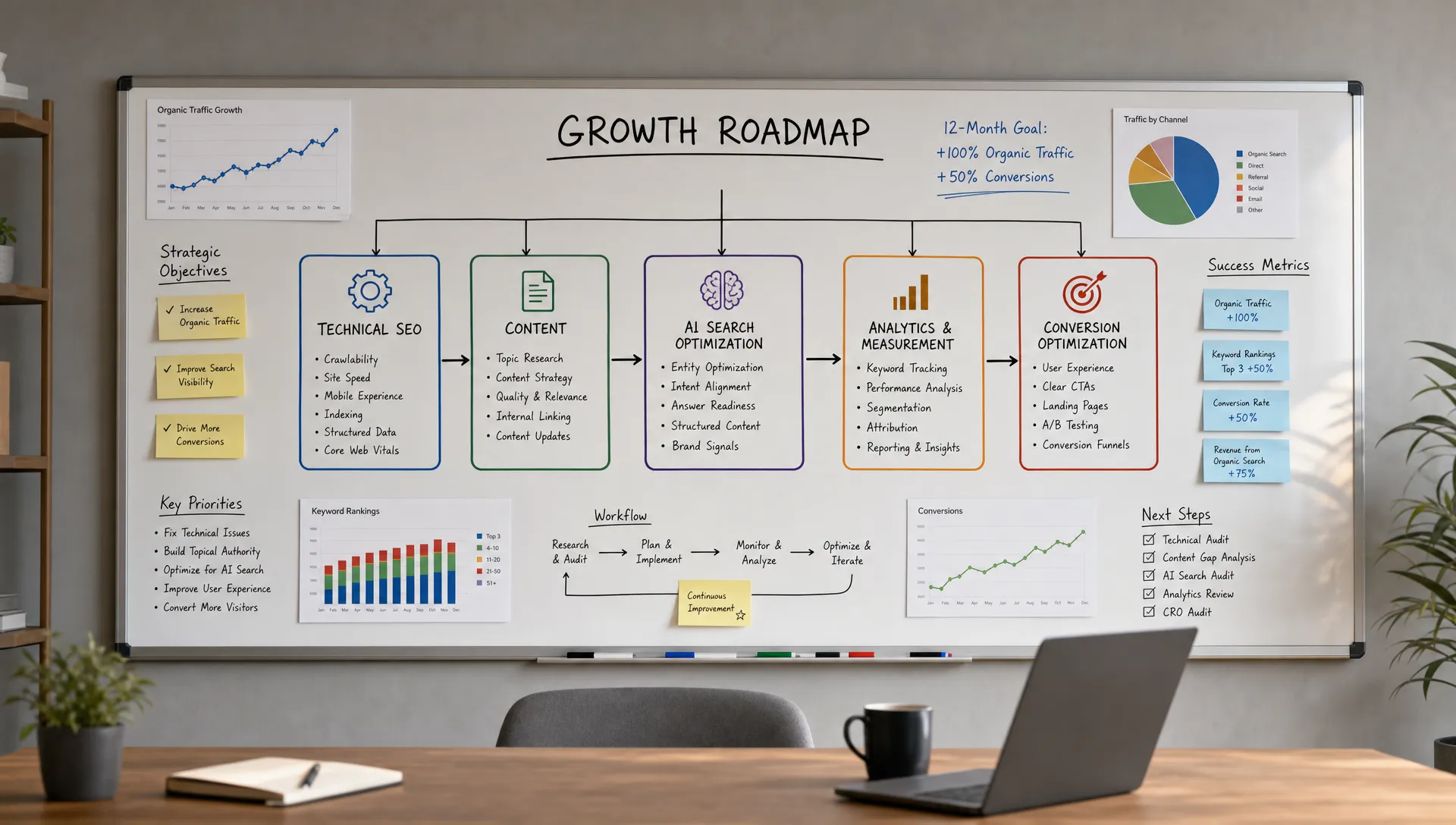
Still, serious SEO services in 2026 should cover strategy, technical SEO, content, AI search optimization, conversion support, and measurement. If one of those pieces is missing, SEO can become activity without business impact.
| SEO service area | What it should include in 2026 | Why it matters |
|---|---|---|
| Strategy | Audience research, search intent mapping, competitor analysis, and revenue-focused prioritization | Prevents scattered execution and connects SEO to business outcomes |
| Technical SEO | Crawlability, indexing, site architecture, schema, page speed, Core Web Vitals, and JavaScript checks | Helps search engines access, understand, and evaluate your site |
| Content | Helpful pages, topical authority, expert input, original insights, refreshes, and internal linking | Builds trust and captures demand across the buyer journey |
| AI search optimization | Answer-focused content, entity consistency, structured information, and citation-worthy assets | Improves visibility in AI-assisted discovery environments |
| Conversion support | Landing page UX, calls to action, offer clarity, trust signals, and analytics | Turns organic traffic into leads, sales, or booked calls |
| Measurement | Dashboards, attribution context, leading indicators, and revenue metrics where possible | Shows whether SEO activity is creating business value |
03
Expect a sharper focus on search intent and revenue
Keyword volume is useful, but it is not a strategy. In 2026, SEO providers should prioritize the intent behind a search, not just the number of searches it receives.
A broad informational keyword may attract thousands of visits but generate few qualified leads. A lower-volume comparison query may bring fewer visitors but much stronger buying intent. A brand-new category term may show limited search volume today but represent an emerging market that your company can own early.
A strong SEO partner should explain which topics educate, which pages convert, and which assets build trust before a sales conversation. The better question is not how many blog posts can be published. It is which pages will create the most visibility, credibility, and conversion impact over the next six to twelve months.
A practical way to pressure-test this is to ask whether each target page has a clear job: discoverability, trust-building, conversion, retention, or internal-link support. If the provider cannot map the page to one of those jobs, the keyword probably belongs lower on the roadmap.
04
Technical SEO is still foundational
AI has not removed the need for technical SEO. If anything, technical clarity is more important because search systems and AI-assisted discovery tools rely on well-structured, accessible information.
In 2026, technical SEO services should cover crawlability, indexation, redirects, broken links, canonical tags, XML sitemaps, robots directives, duplicate content, mobile usability, site architecture, and structured data.
Google's Core Web Vitals continue to push websites toward better real-world user experience. Interaction to Next Paint, or INP, became a Core Web Vital in 2024 and measures responsiveness across user interactions. For business owners, the takeaway is simple: technical SEO is not just for search engines. A slow, confusing, or poorly structured site also reduces conversions.
If the engagement includes platform or tool decisions, compare the working stack before buying more software. The best search engine optimization tools for 2026 guide explains which tools fit technical audits, reporting, content optimization, and AI visibility workflows.
05
Content must prove expertise, not just target keywords
Generic content is one of the weakest SEO investments a company can make. Search engines and AI systems have become better at identifying pages that repeat surface-level information without adding much value.
Good SEO content should be built around real expertise. That may include customer insights, original examples, product knowledge, founder perspectives, industry experience, research, case studies, screenshots, frameworks, or data your competitors do not have.
Expect your SEO provider to ask sharper questions. Who is the page for? What decision is the reader trying to make? What objections do they have? What proof would make them trust you? What should they do next? If those questions are missing, the content strategy is probably too shallow.
06
AI search optimization is becoming part of SEO
AI search optimization, answer engine optimization, and generative engine optimization are becoming normal parts of SEO services. The goal is to make your brand, content, and expertise easier for AI-assisted systems to understand and reference.
This does not mean chasing every AI trend. It means creating clear, authoritative, well-structured information that answers real questions and reinforces your brand's relevance across the web.
Practical AI search optimization may include concise answer sections, stronger entity signals, consistent brand descriptions, structured data, expert-authored content, comparison pages, FAQ content, digital PR, review strategy, and content that earns citations from trusted sources.
07
AI should improve SEO execution, not replace judgment
AI tools can make SEO workflows faster. They can help analyze large keyword sets, cluster topics, draft outlines, summarize competitor pages, generate schema ideas, review internal linking opportunities, and speed up reporting.
But AI should not replace strategy, accuracy, or subject-matter expertise. Google has said AI-generated content is not automatically against its guidelines, but using automation primarily to manipulate search rankings is a problem.
Expect an SEO provider to use AI responsibly: human review, fact-checking, expert input, brand alignment, and editorial standards. If an agency's main value proposition is producing hundreds of AI-written articles per month, be cautious.
08
Reporting should connect SEO work to business outcomes
Rank tracking still has a place, but it should not be the only measure of success. Search results vary by location, personalization, device, query wording, and SERP features. AI-generated answers also make visibility more complex to measure.
SEO reporting in 2026 should include leading and lagging indicators. Leading indicators show whether the strategy is gaining traction. Lagging indicators show whether that traction is turning into business value.
A reporting setup should connect measurable website actions such as calls, form submissions, WhatsApp clicks, demo requests, resource downloads, and article-to-service-page clicks with the organic pages that created them.
| Metric type | Examples | What it tells you |
|---|---|---|
| Visibility | Keyword movement, impressions, share of voice, AI answer presence where measurable | Whether your brand is becoming easier to find |
| Engagement | Organic clicks, scroll depth, time on page, assisted journeys | Whether visitors find the content useful |
| Technical health | Indexed pages, crawl errors, Core Web Vitals, structured data issues | Whether your site supports search performance |
| Authority | Referring domains, quality mentions, branded searches, reviews | Whether trust and recognition are growing |
| Conversion | Form fills, calls, demo requests, purchases, booked consultations | Whether SEO is contributing to revenue opportunities |
09
The first 90 days should be structured, not random
When you start working with an SEO provider, the first few months should create clarity and momentum. You should not expect overnight results, but you should expect a clear process.
The exact timing varies, especially for larger websites or competitive markets. But if the first 90 days are filled with disconnected tasks and vague updates, that is a warning sign.
Ask for evidence, not just task names. In SitesBrand's anonymized case studies, the measured proof is operational: Trackora brought 8,347 shipments into a real-time view, Finovo tracked 1,246 invoices in one workflow, and Healthify supported 3,892 appointments plus 2,341 new-patient actions. Those numbers are not SEO guarantees; they show the kind of concrete baseline a serious growth project should be able to define.
| Timeframe | Typical focus | Expected output |
|---|---|---|
| Days 1 to 30 | Audit, discovery, analytics review, competitor research, technical assessment | Clear diagnosis, priority issues, opportunity map |
| Days 31 to 60 | Strategy, content roadmap, technical fixes, page prioritization | Execution plan tied to business goals |
| Days 61 to 90 | Implementation, publishing, optimization, reporting setup | Early improvements, baseline metrics, next-phase roadmap |
10
SEO services should include conversion thinking
Traffic without conversion is expensive, even when the traffic is organic. If your site attracts the right visitors but fails to explain your offer, build trust, or guide action, your SEO investment will underperform.
Modern SEO engagements often overlap with UI/UX design, landing page strategy, copywriting, analytics, and conversion rate optimization. This does not mean every SEO provider needs to be a full design agency. It does mean they should understand how organic visitors move from question to decision.
In a mature engagement, SEO strategy connects with SEO growth engine work, web automation systems, analytics, sales handoff, and page-level conversion improvements only where those pieces directly support the search goal.
11
What SEO services should not promise in 2026
The SEO industry still has shortcuts and unrealistic claims. A credible provider should be confident, but not reckless.
Strong SEO compounds over time, but it is not magic. It depends on competition, website quality, market demand, budget, authority, execution speed, and how well the strategy aligns with customer behavior.
- Guaranteed number-one rankings for competitive keywords.
- Hundreds of backlinks with no quality explanation.
- Massive AI content production without expert review.
- One-size-fits-all packages with no strategy phase.
- Reports that only show rankings and ignore conversions.
- Technical fixes with no explanation of business impact.
- Claims that SEO can replace brand, product, or sales fundamentals.
12
How to choose an SEO provider in 2026
When evaluating SEO services, look beyond deliverables. A list of tasks can sound impressive while still failing to create growth. The better evaluation is whether the provider can think strategically and execute consistently.
Ask how they prioritize opportunities, connect SEO work to qualified leads or revenue, approach AI search optimization, handle technical SEO, ensure content reflects real expertise, report beyond rankings, and collaborate with design, development, sales, or internal teams.
The right partner should answer clearly without hiding behind jargon. They should also be honest about tradeoffs. Not every keyword is worth targeting. Not every page needs to be created. Not every technical issue is urgent. Good SEO requires prioritization.
13
Build an SEO system that matches how search works now
SEO services in 2026 should help your business become visible, trusted, and chosen across a more complex search landscape. That requires more than keywords and monthly reports.
The strongest SEO systems combine technical strength, expert content, AI search readiness, conversion-focused pages, automation where it helps, and measurement tied to real growth.
If you want a strategy-led approach, SitesBrand builds psychology-driven, AI-powered digital growth systems across SEO, AI search optimization, automation, web development, and conversion-focused design. Start with a clear audit, identify the highest-impact opportunities, and build an SEO system designed for the way customers search today.
14
Frequently asked questions
Are SEO services still worth it in 2026?
Yes. SEO services are still worth it when they focus on business outcomes, not vanity metrics. Buyers still use search engines and AI-assisted tools to research problems, compare providers, and make decisions.
How long does SEO take in 2026?
Many websites see early movement within a few months, but meaningful growth often takes six to twelve months or longer depending on competition, site history, content quality, technical health, and execution speed.
What is the difference between SEO and AI search optimization?
SEO improves visibility in search engines. AI search optimization makes your brand and content easier for AI-assisted systems to understand, trust, and reference. In 2026, the two are increasingly connected.
Should SEO services include content creation?
Usually, yes. Content is still central to organic visibility, but it should be based on strategy, intent, expertise, and conversion goals. Publishing generic keyword articles is not enough.
Can AI handle SEO content by itself?
AI can support research, outlines, drafts, optimization, and analysis, but it should not replace expert judgment. Strong SEO content still needs accuracy, original insight, brand voice, and human review.
What should an SEO report include?
A useful SEO report should include visibility, technical health, content performance, authority signals, conversions, and strategic next steps. Rankings matter, but they are only one part of the picture.